

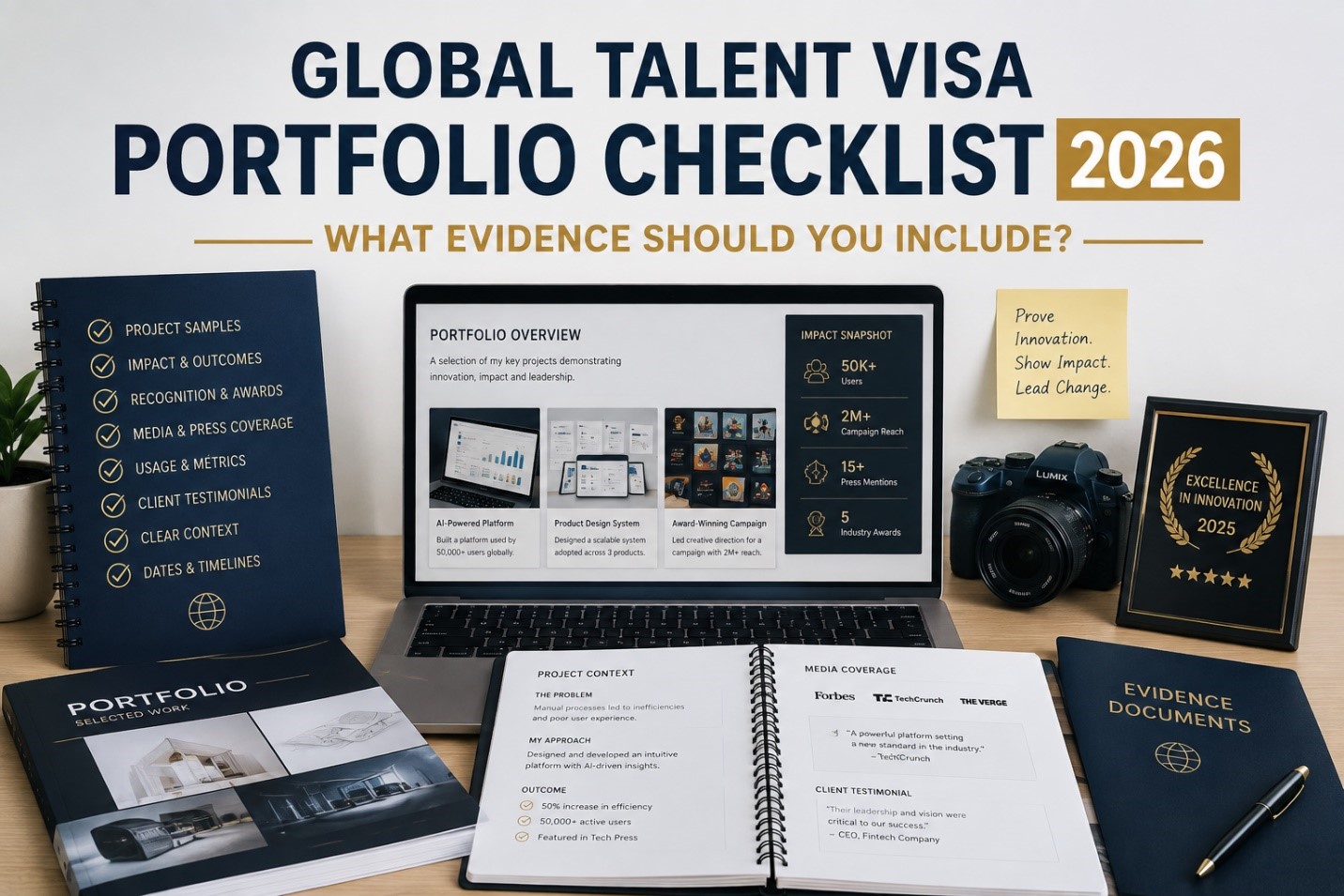
A portfolio is one of the most persuasive parts of a Global Talent Visa application when it is built well, and one of the weakest when it is not. Unlike a CV or personal statement, a Global Talent Visa portfolio lets reviewers see your work directly rather than reading a description of it. Going into 2026, expectations around what a strong portfolio should include have become more specific, and applicants who treat it as an afterthought tend to submit thinner cases than they need to.
This checklist walks through what belongs in a well-built Global Talent Visa checklist for your portfolio, how to organise it, and where applicants commonly fall short.
Why Your Portfolio Carries So Much Weight
Written claims are easy to make. A portfolio makes them harder to dispute. If you say you designed an award-winning product, built a widely used platform, or produced influential creative work, a well-curated portfolio lets a reviewer see the evidence directly rather than taking your word for it. This is why Global Talent portfolio evidence often has more persuasive weight, document for document, than almost anything else in your application.
It also gives reviewers context they cannot get elsewhere. A single screenshot of an app rarely tells the full story, but a portfolio that includes design process, outcomes, and third-party recognition builds a much richer, more credible picture of your work.
The Core Checklist for 2026
While exact requirements vary by route, most strong portfolios in 2026 include the following elements:
- A short introduction explaining your role and specific contribution to each featured project.
- Visual or written samples of your best, most relevant work, clearly dated.
- Context for each project: the problem, your approach, and the measurable outcome.
- Evidence of recognition tied to the work, such as press coverage, awards, or client testimonials.
- Usage or impact data where available, such as audience reach, sales figures, or adoption numbers.
- Clear labelling and consistent formatting so reviewers can navigate quickly between projects.
The strongest portfolios are curated, not comprehensive. Including every project you have ever worked on dilutes the impact of your best work. Aim for a smaller number of standout pieces, each supported by real context and outcomes, rather than a long list of minor contributions.
Meeting Global Talent Portfolio Requirements by Route
Portfolio expectations shift depending on your field. A designer or artist’s portfolio will lean heavily on visual samples and critical or press recognition, while a technologist’s portfolio may focus more on product outcomes, technical documentation, and usage metrics. Researchers, meanwhile, often build a portfolio around published work, citation data, and evidence of influence within their field.
Whatever your route, the underlying Global Talent portfolio requirements stay consistent: clarity of contribution, evidence of quality, and proof of recognition or impact. Tailor the format to your field, but keep the underlying structure focused on these three pillars.
Organising Your Portfolio for Fast Review
Reviewers move through a high volume of applications, so structure matters as much as content. Group your portfolio by project or theme rather than chronologically dumping everything together. Open with your strongest piece of work, since first impressions genuinely influence how the rest of the portfolio is read.
Keep file formats simple and accessible. PDFs with embedded images tend to work more reliably than links to external sites, which can break, require login access, or simply go unclicked. If external links are necessary, back them up with screenshots inside the main document.
Common Portfolio Mistakes to Avoid
The most common issue is including work without explaining your individual contribution, particularly for team-based projects. A stunning piece of design or a highly successful product means very little to a reviewer if it is unclear what part of it was actually yours. Always be explicit about your specific role.
Another frequent mistake is outdated content. A portfolio dominated by work from many years ago can suggest stalled momentum, even if your recent work is stronger. Prioritise recent projects, and where older work is included, pair it with something current to show continued growth.
How Much Is Too Much?
A question we hear often is simply how many pieces of work to include. There is no fixed number, but as a general guide, most strong portfolios feature between six and twelve well-documented pieces of work rather than a handful of thin entries or an overwhelming archive of everything ever produced. What matters more than the count is that every single piece included earns its place, with clear context, real outcomes, and a defensible reason for being there.
If you are unsure whether to include a piece of work, a useful test is to ask whether it strengthens your weakest evidence category or simply repeats a point you have already made elsewhere. Evidence that fills a genuine gap is worth including. Evidence that just adds bulk usually is not.
Building a Portfolio That Does Its Job
A well-built portfolio does not just showcase your work, it makes your entire application easier to believe. When it is curated, clearly labelled, and backed by real outcomes and recognition, it becomes one of the most persuasive documents in your Global Talent Visa file.
At Horizon Bloom Consulting, we help applicants review, structure, and strengthen their portfolios as part of our non-legal endorsement preparation services. We do not provide immigration or legal advice, and applicants should appoint a regulated adviser for visa filing. If you want a professional review of your portfolio ahead of submission, book a consultation with our team.
