

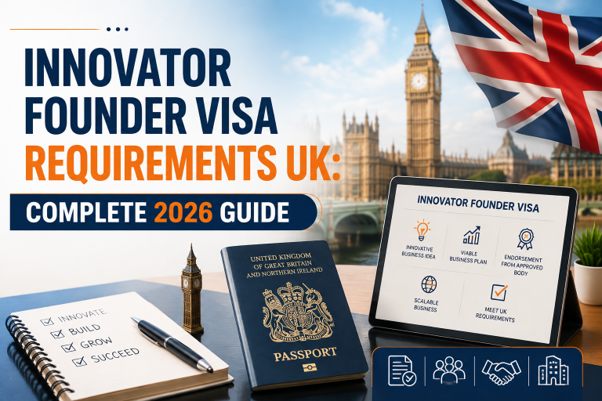
The 2026 Innovator Founder visa requirements UK focus on people who want to create and actively lead an original venture in Britain. This is not a general route for purchasing an existing company, opening a standard local business, or making a passive investment. A founder must bring a credible idea, explain the market problem it solves, and show how the venture can develop beyond its earliest stage. The application therefore combines personal suitability with an assessment of the proposed business.
Anyone researching startup visa requirements UK should note that the former Start-up route is closed to new applicants. Qualifying entrepreneurs now consider the Innovator Founder route, which grants permission for three years. Eligible partners and children may apply as dependants, while founders who later satisfy the separate settlement rules may apply for indefinite leave to remain after three years. The route begins with endorsement and continues through business progress checks.
How the Business Idea Is Judged
A founder needs more than an attractive pitch when applying through the innovative business visa UK route. The venture must be new, viable, and scalable. New means the applicant cannot simply join a company that is already trading. Innovation requires a new strategy that satisfies a market need or provides a significant competitive advantage. Viability looks at whether the model is reasonable given the skills, knowledge, resources and understanding of the market of the founder.
Scalability looks at more than one operation and asks whether the concept can grow in an organised, sustainable way. During a review of business eligibility UK, assessors expect growth, job creation, capacity and expansion into international markets. The applicant must have created the plan or contributed to it and be the founder or a founding-team member. Passive investors without responsibility do not qualify.
Why Endorsement Comes Before the Visa
Before applying for the visa, the founder must obtain endorsement from an organisation authorised by the Home Office. The endorsing body examines the proposal, the applicant’s role, commercial credibility, and the source of any funds going into the venture. This stage is where the Innovator Founder visa requirements UK become practical: the plan, founder profile, market evidence, and finances must align.
The endorsement letter must normally be dated no more than three months before the immigration application. Applicants should approach only bodies on the list and should understand each provider’s assessment process before submitting material. After the visa is granted, the founder must attend at least two contact-point meetings, around months 12 and 24, to demonstrate progress. An endorsing body may withdraw support when the venture is abandoned, or route conditions are no longer met.
Personal Conditions and Evidence Checklist
Personal requirements matter alongside the business proposal. Anyone comparing startup visa requirements UK with the current route should prepare evidence of English ability at CEFR level B2 unless an exemption applies. Applicants entering from overseas, or applying inside the UK after holding permission for less than 12 months, normally need £1,270 in maintenance funds held for 28 consecutive days. Additional amounts apply when eligible dependants are included.
The supporting file should remain orderly, current, and consistent with the business plan. It should also explain how personal evidence supports the wider case for an innovative business visa UK application rather than appearing as unrelated paperwork.
- Valid passport and proof of identity for visa submission.
- Endorsement letter issued within the permitted validity period.
- English-language evidence clearly showing no exemption applies.
- Bank statements clearly demonstrating the required maintenance funds.
- Tuberculosis certificate and certified translations where they apply.
What Approval Means for the Founder
After endorsement, the founder completes the visa application online and provides identity and supporting documents. The immigration form, business plan, endorsement letter, and personal evidence should present one consistent account of the venture. At this point, business eligibility in the UK remains important because discrepancies can weaken an otherwise credible case. Successful applicants normally receive three years of permission and may establish businesses, work for their venture, and bring eligible dependants.
During the three-year grant, the holder can direct the endorsed venture and may take qualifying work outside it when the job meets the required skill level. Professional sportsperson work is not permitted. Settlement is a separate assessment requiring business progress, a new endorsement, continuous residence, and the Life in the UK Test where applicable. Meeting the Innovator Founder visa requirements in the UK begins the founder’s continuing responsibilities.
Conclusion
A strong Innovator Founder application is built on consistency. The business idea, market evidence, financial assumptions, founder experience, and endorsement materials should all support the same credible story. Applicants also need to understand that approval creates ongoing duties, including active management and progress reviews with the endorsing body. Horizon Bloom Consulting can help founders examine eligibility, organise evidence, prepare for endorsement, and identify weaknesses before formal submission. Careful preparation does not guarantee a visa decision, but it can make the case clearer, more accurate and easier to assess. Before spending any money or sending off an application, make sure you check the current official rules.
