For years, the UK’s Global Talent visa has opened doors for scientists, tech founders, academics, and artists. One group, however, has always sat awkwardly at the edges of the arts and culture criteria: commercial designers. A graphic designer building brand identity, a product designer shaping items for mass production, or a service designer redesigning how a company’s customers interact with it rarely fit neatly into the old “arts” framework, and they didn’t fit into architecture, fashion, or digital design endorsement either. That gap has now closed. Since 1 July 2026, the Home Office and Arts Council England have recognised design as its own endorsement category under the Global Talent route, with a brand-new endorsing partner, the Design Business Association (DBA), assessing applications on Arts Council England’s behalf. If you’ve spent your career designing products, brands, interiors, or services rather than exhibiting art or writing code, this route was built with you in mind. Here’s what the new Design Industry pathway actually covers, who can apply, and what it takes to put together an endorsement application that stands a genuine chance of success. Who Reviews a Design Industry Application? Design sits under Arts Council England’s arts and culture umbrella in the same way architecture and fashion design do, but Arts Council England doesn’t make the substantive decision itself. Once an application reaches them, it’s passed to the DBA, a body made up of design-industry professionals who understand what “significant” recognition actually looks like in fields like brand design or exhibition design. The DBA reviews the evidence and recommends an outcome, Arts Council England relays that decision, and UK Visas and Immigration issues the final word. Applicants never deal with the DBA or Arts Council England directly everything is submitted through the standard GOV.UK Global Talent endorsement form. Which Design Disciplines Actually Qualify This is where the route gets specific, and where a lot of applicants trip up before they’ve even started. The DBA’s remit covers design work that is commercial and functional in nature created for mass production, practical use, or a business setting. That includes: Graphic design Brand design Motion graphics design (excluding film and TV work) Product design and development (excluding digital product design) Furniture design (excluding bespoke or artistic pieces) Commercial interior design (excluding residential/domestic projects) Exhibition design and display (excluding art exhibitions or museum curation) Service design Notice the pattern in the exclusions this route wants work made for the market, not one-off artistic pieces. That’s a genuine reversal from how many creative endorsement categories operate, where commercial work can sometimes count against an applicant rather than for them. Just as important is knowing what doesn’t belong here. Architecture, landscape and urban design fall under RIBA’s endorsement remit. Fashion design, textiles, jewellery design, and craft sit elsewhere in the arts and culture structure. UX/UI, digital product design, games design, and visual effects are considered digital technology disciplines. Illustration is excluded outright it isn’t treated as design at all under this guidance. Set and costume design for film, TV, or theatre also fall under separate endorsing bodies. If your practice straddles two of these areas, it’s worth working out which body’s criteria your strongest evidence actually supports before you build an application around the wrong one. Exceptional Talent or Exceptional Promise? Like every other Global Talent field, designers apply under one of two tracks. Exceptional Talent is for those already recognised as leaders in their discipline, typically with a substantial professional track record. Endorsement under this route leads to settlement after three years. Exceptional Promise is for designers earlier in their career who are on a credible trajectory toward that leadership status, generally with a track record built over the last few years rather than a decade. Endorsement here leads to settlement after five years. Choosing the right track matters more than people expect. Applying as “promise” when your career history reads as an established talent or the reverse is one of the more common reasons applications stall. Be honest about where your evidence actually places you. What Evidence Does the DBA Expect? The evidence requirements follow Arts Council England’s standard structure for endorsement applications, so if you’ve researched other creative Global Talent routes, the shape will look familiar: A CV setting out your professional design career and education to date. Three letters of recommendation, each written by someone you’ve worked with in a design capacity. Two must come from well-established design organisations, at least one of which is UK-based. The third can come from another well-established design organisation, in the UK or abroad, or from an individual recognised as an expert in your specific field. Each letter needs to explain what you’d bring to the UK design industry, be signed and dated, and come with the referee’s own CV or biography attached a generic testimonial won’t cut it. Ten pieces of evidence, drawn from at least two of the following three categories, all dated within the last five years: Appearances and distribution proof your work has been exhibited, published, or distributed in a way that carries recognised significance in the design world. Physical proof matters here: invitations, contracts, and CVs don’t count as evidence of appearance, so think exhibition catalogues, retailer listings, or user numbers for a product or service you built. Awards a win, nomination, or shortlisting for a recognised design award. Talent-track applicants need international awards; promise-track applicants can rely on national or international recognition, including student-level accolades. Media coverage critical coverage of your work from a named, verifiable critic, not a passing product mention. How the Application Actually Moves Through the System Applications for Stage 1 endorsement go through GOV.UK, where you’ll select the design industry field, submit your Stage One form, and send your evidence by email as instructed in the guidance. From there, the Global Talent Team forwards everything to the DBA for review. A decision on endorsement typically comes back within around eight weeks. If endorsed, you move on to the Stage 2 visa application, which can be submitted from

Global Talent Visa: The New Design Industry Route Explained


Global Talent Visa: The New Design Industry Route Explained


UK Launches Dedicated Design Route Under Global Talent Visa: What Changed on 1 July 2026
For years, designers applying for the UK Global Talent Visa faced an awkward fit. Product designers, UX and UI designers, industrial designers, and brand or service designers had no category built for them. They were left trying to squeeze commercial, applied work into the Arts and Culture route, which was really built around visual arts, or the Digital Technology route, which was built around software and technical product roles. Neither one described what most designers actually do. That changed on 1 July 2026. Following the March 2026 Statement of Changes to the Immigration Rules (HC 1691), the Home Office introduced a dedicated Design Industry endorsement pathway under Appendix Global Talent. For the first time, design has its own home within the route, with its own criteria, its own assessing body, and its own evidence expectations. This article breaks down exactly what changed, who the new Global Talent Visa design route is for, and what applicants need to prepare. Why the UK Created a Separate Design Route Until this update, design applicants were essentially guests in categories designed around other disciplines. A product designer might frame their portfolio as fine art to satisfy an Arts Council assessor, or reframe their process as software engineering to fit under Tech Nation’s digital technology criteria. Both approaches meant misrepresenting the actual nature of the work, and it made endorsement harder to secure even for genuinely strong applicants. The Home Office’s explanatory memorandum for HC 1691 frames the change as an effort to make it easier for top design talent to use the Global Talent route on terms that reflect their profession. In practice, that means design is now treated as a distinct, strategic field within the UK’s talent immigration system, alongside architecture, fashion, and film and television, rather than a loose subset of visual arts. Who Assesses the New Design Route Design Industry endorsement applications are judged by the Design Business Association (DBA), acting on behalf of Arts Council England. This puts design assessment in the hands of a body with direct sector expertise, rather than leaving reviewers to interpret commercial and applied design work through a general arts and culture lens. For applicants, this should mean assessors are more familiar with the norms of the field, from client-based product work to interface design systems that never touch a gallery wall. Who the Design Route Is For The new pathway is aimed at applicants who are professionally engaged in producing outstanding applied, published, distributed, or internationally exhibited design work, and who can show regular professional engagement in the design field over the last five years. In practical terms, this covers a wide range of disciplines that previously had no clear category: Product and industrial designers developing physical goods, devices, or manufactured products. UX and UI designers working on digital product interfaces and user experience systems. Graphic and brand designers producing visual identity, packaging, or communication design. Service designers shaping how organisations deliver structured customer or user experiences. Other applied design professionals whose work is commercial or functional rather than purely fine art. This is a meaningful shift for anyone whose career sits in commercial or applied design rather than gallery-based visual art, since it finally gives that work a route where the criteria match the reality of the job. Exceptional Talent vs Exceptional Promise for Designers As with other Global Talent fields, the Design Industry route distinguishes between two levels. Exceptional Talent applicants need to show a substantial track record in at least two countries, positioning them as already-recognised leaders in the design field. Exceptional Promise applicants, by contrast, need to be at an early stage in their career and demonstrate a developing track record in one or more countries, showing clear potential to become a future leader rather than an already-established one. Choosing the right level matters. Applying under Exceptional Talent without a genuinely established international track record is one of the fastest ways to see an otherwise promising case refused, while applying under Exceptional Promise as a fallback for weak Exceptional Talent evidence rarely works either, since the Promise criteria still require a persuasive, well-evidenced professional record. What Evidence the New Route Requires Design applicants need a CV and three dated recommendation letters. Two of these need to come from well-established design organisations the applicant has worked with in a design capacity, and which are acknowledged as experts in the applicant’s field, with at least one of those organisations based in the UK. The third letter can come from another well-established design organisation, or from an individual the applicant has worked with in a design capacity who holds recognised experience in the relevant design field. Beyond the letters, applicants need at least two forms of qualifying evidence under the applicable Exceptional Talent or Exceptional Promise criteria. This can include media recognition, international design awards, and evidence of professional appearances, publications, exhibitions, or international distribution and sales. As with other Global Talent fields, evidence needs to prove personal contribution clearly, not just point to a successful project or studio. Design work is often collaborative, so where a portfolio piece involved a wider team, the applicant’s specific role needs to be identifiable rather than assumed. What This Means If You Are Applying If you previously considered the Global Talent Visa and found that neither Arts and Culture nor Digital Technology fit your design work, this update is worth revisiting. The new Design Industry route gives commercial and applied designers a pathway built around how the profession actually works, assessed by a body with direct sector knowledge rather than a general arts panel. That said, a new route does not mean a lower bar. The evidential requirements are just as demanding as other Global Talent fields, and as with any newly opened pathway, guidance and assessor expectations may continue to be refined as more applications are processed. Anyone applying under this route should check the current published criteria before submitting, since detail can shift as the DBA and Arts Council England gain experience assessing

Global Talent Visa Evidence: How to Choose the Right 10 Documents for Your Application
If you have started researching the UK Global Talent Visa, you already know one thing: evidence is everything. The endorsement panel does not know you personally. They cannot see the late nights, the risks you took, or the projects that quietly changed how your industry works. All they have is what you put in front of them. That is why choosing the right Global Talent Visa evidence is arguably the single most important decision you will make in this entire process. Most applicants do not fail because they lack achievements. They fail because they submit the wrong evidence, in the wrong format, telling the wrong story. This guide walks through how to think about your Global Talent evidence documents, what the ten strongest categories usually look like, and how to avoid the mistakes that quietly sink otherwise strong applications. Why Global Talent Visa Evidence Matters More Than You Think Endorsing bodies are not evaluating your potential in the abstract. They are checking your file against specific, published criteria, and every claim you make needs a document behind it. Say you led a product that scaled internationally. Fine, but where is the proof? A press mention, a company announcement, a metrics screenshot, a reference letter from someone senior who watched it happen. Without that backing, even a genuinely impressive career story reads as unverified opinion. This is where Global Talent application evidence becomes a strategic exercise rather than a paperwork chore. You are not just proving that things happened. You are proving they happened at a level that meets the bar for exceptional talent or exceptional promise, and that the evidence is credible, current, and clearly attributable to you. What Endorsing Bodies Actually Look For Across every route, whether tech, arts, academia or research, reviewers are broadly looking for three things in your: recognition by others in your field, measurable impact, and a track record that suggests you will keep contributing to the UK sector you are applying under. Evidence that ticks only one of these boxes tends to be weaker than evidence that speaks to all three at once. A conference keynote invitation, for example, shows recognition. Pair it with attendance numbers or audience feedback, and it starts to show impact too. The 10 Document Types That Strengthen a Global Talent Application There is no single formula, but strong applications tend to draw from a similar pool of Global Talent evidence documents. Here are the ten categories worth prioritising: Media coverage: articles, interviews, or features in recognised publications relevant to your field. Awards and honours: shortlists count too, not only wins, especially from respected industry bodies. Publications: papers, whitepapers, technical writing, or widely read articles that demonstrate original thinking. Letters of recommendation: written by senior, credible referees who can speak directly to your impact. Proof of professional standing: salary evidence, seniority, or role scope that shows you operate at a high level. Evidence of impact: user numbers, revenue growth, adoption metrics, or case studies tied to your work. Speaking engagements: invitations to conferences, panels, or industry events as a recognised voice. Intellectual property: patents, open-source contributions, or proprietary methods you created. Project outcomes: before-and-after results that show what changed because you were involved. Membership and affiliations: fellowships, advisory roles, or standing with respected professional bodies. Not every applicant will have all ten. That is expected. The goal is not volume, it is picking the strongest three or four categories where your evidence is genuinely compelling, then building a narrative around them rather than diluting your file with weak, tangential documents. How to Select the Right Evidence for Your Profile Start by mapping your career highlights against the criteria for your specific route. A founder’s strongest Global Talent Visa evidence usually centres on growth metrics and investment, while a researcher’s file leans on citations and peer recognition. Once you know your strongest categories, work backwards: what documents actually exist to support each claim, and which ones are missing but could still be obtained in time, such as a fresh reference letter or an updated metrics report. It also helps to think about redundancy. If three documents are proving the same point, one strong version is usually better than three mediocre ones. Reviewers read a lot of applications. Evidence that is easy to verify and clearly labelled will always outperform a thick, unfocused folder. Common Mistakes When Choosing Application Evidence The most frequent error is submitting evidence that proves activity rather than achievement. Attending an event is not the same as being invited to speak at one. Being part of a large team project is not the same as leading it. Reviewers are trained to spot the difference, so vague or generic documents tend to work against you rather than for you. Another common issue is outdated evidence. A media mention from six years ago carries far less weight than recent recognition, particularly for fast-moving fields like technology. Where possible, prioritise documents from the last two to three years, and where older evidence is included, pair it with something current to show continued momentum. Bringing It All Together Choosing the right Global Talent Visa evidence is less about ticking boxes and more about building a coherent, well-supported case for why you belong in this category. Every document should answer a simple question: does this make my achievement more believable, more measurable, or more recognised? If the answer is yes, it earns its place in the file. At Horizon Bloom Consulting, we work with applicants to review their background, identify their strongest evidence categories, and structure a submission-ready endorsement pack. Our support is limited to the endorsement preparation stage and does not constitute immigration or legal advice, but if you are unsure which documents will carry the most weight in your case, a structured review can save you months of guesswork. Explore our Global Talent Endorsement services or book a consultation to talk through your evidence strategy.
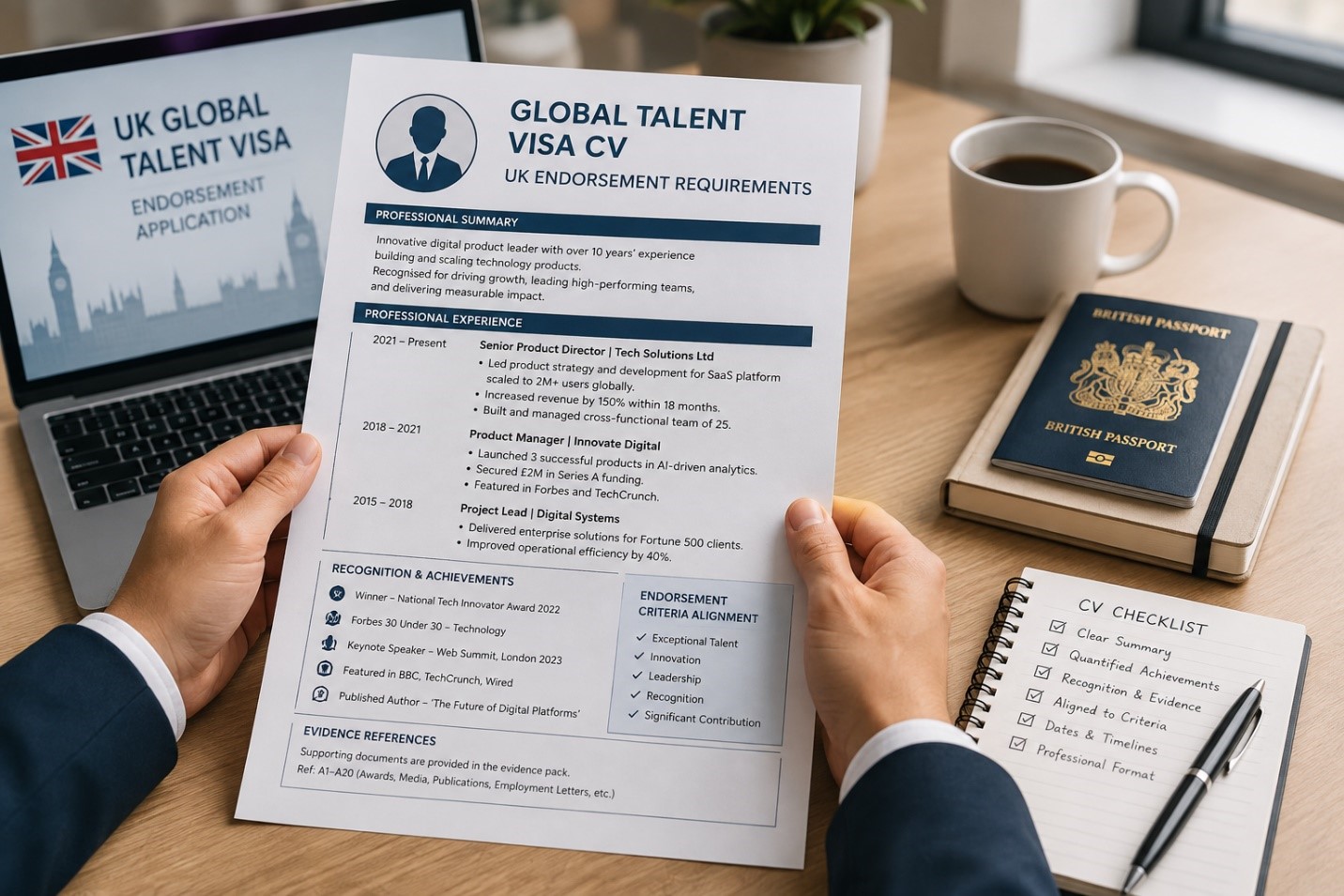
How to Build a Global Talent Visa CV That Meets UK Endorsement Requirements
Your CV is usually the first document a reviewer opens, and in a Global Talent Visa application, it is doing far more work than a typical job-application CV ever would. It is not just introducing you. It is framing every piece of evidence that follows. Get the Global Talent Visa CV format wrong, and even a strong application can feel disorganised before the reviewer reaches your strongest material. This guide breaks down what UK endorsement bodies expect from a Global Talent CV, how it differs from a standard professional resume, and the structural choices that make your achievements easier to verify and harder to overlook. Why a Standard CV Does Not Work Here A conventional job CV is built to get you an interview. It is short, skimmable, and light on detail by design. A Global Talent Visa CV has the opposite job: it needs to demonstrate, in detail, that your career meets the specific endorsement criteria for your route. That means more depth, more evidence-linked detail, and a structure that mirrors how endorsement bodies actually assess applications rather than how recruiters skim resumes. Reviewers are not just checking where you worked. They are checking what you achieved, how it was recognised, and whether it aligns with the mandatory and optional criteria for exceptional talent or exceptional promise. If your CV reads like a job history rather than an evidence-backed track record, it will not do its job. Core Global Talent CV Requirements While every route has its own nuances, most strong Global Talent CVs share a similar backbone: A clear professional summary that states your field, seniority, and the endorsement criteria your career supports. A reverse-chronological work history focused on outcomes, not just responsibilities. Quantified achievements wherever possible, such as growth figures, funding raised, or audience reach. A dedicated section for recognition: awards, media, speaking engagements, and publications. Clear links or references pointing to supporting evidence documents included elsewhere in your application. This structure gives reviewers a fast, logical path from claim to proof, which is exactly what strengthens Global Talent CV guidance in practice: it is not about writing more, it is about writing in a way that is easy to verify. Formatting Choices That Actually Matter Endorsement panels read a high volume of applications, so clarity beats creativity. A clean, well-labelled document with consistent headings will always outperform a heavily designed CV that prioritises visual flair over readability. Stick to a simple, professional layout, use consistent date formats, and avoid dense paragraphs that bury your best achievements. Length is another common question. There is no strict word limit, but most strong Global Talent Visa CVs run two to four pages. Long enough to properly evidence a career, short enough to stay focused. If you find yourself padding sections just to fill space, that is usually a sign the content needs tightening rather than expanding. How to Present Achievements So They Meet Endorsement Criteria The strongest CVs do not just list what you did, they connect each achievement back to a specific endorsement criterion. Instead of writing that you “led product development,” a stronger line ties the same fact to impact: “Led product development for a platform that scaled to over two million users within eighteen months, resulting in national media coverage.” This small shift turns a job description into evidence. Where possible, group achievements around themes that mirror your endorsement route, such as innovation, leadership, or industry recognition. This makes it easier for a reviewer to quickly map your career onto the criteria they are assessing you against, rather than having to piece the connection together themselves. Mistakes That Weaken an Otherwise Strong CV The most common issue is vagueness. Phrases like “responsible for strategy” or “involved in a major project” tell a reviewer very little. Be specific about scope, scale, and outcome. Another frequent mistake is omitting dates or timelines, which makes it difficult for reviewers to assess recency, something that matters more than most applicants expect. Finally, avoid duplicating your entire personal statement inside your CV. They serve different purposes: your CV documents your track record, while your personal statement explains your contribution and future plans in narrative form. Overlap is fine, but the CV should stand on its own as a clear, evidence-led summary of your career. Tailoring Your CV to Your Endorsement Route A Global Talent Visa CV for a software engineer will not look the same as one for a choreographer or a research scientist, and it should not. Tech applicants often benefit from including a short technical skills summary and links to shipped products, while academics typically need a more detailed publication and citation history woven into the work section rather than left as a separate list. Arts applicants tend to do better when the CV references specific exhibitions, performances, or commissioned work with dates and venues rather than general descriptions of artistic practice. The underlying Global Talent CV requirements stay consistent across routes: clarity, evidence, and relevance. What changes is which achievements you foreground and how much technical or creative detail a reviewer in that field will expect to see. Building a CV That Supports Your Whole Application A well-built Global Talent Visa CV does more than list your history, it sets up every other document in your endorsement pack to be read with context and credibility. When it is structured around the right criteria, formatted for fast review, and backed by specific, verifiable detail, it becomes one of the strongest assets in your application rather than a formality. At Horizon Bloom Consulting, we help applicants restructure and strengthen their CVs to meet UK endorsement expectations, alongside broader document and evidence support. Our services cover the endorsement preparation stage only and are not a substitute for immigration or legal advice. If you would like a professional review of your CV before submission, get in touch with our team or explore our Global Talent Endorsement services to see how we can help.
Global Talent Visa for Startup Founders: How to Prove Innovation, Impact and Leadership
Founders often assume that building a company is proof enough. Investors backed you, customers pay you, the product exists, surely that speaks for itself. In practice, a UK Global Talent Visa startup founders application needs more than a working business. Endorsing bodies are looking for clear, documented evidence of innovation, measurable impact, and genuine leadership, presented in a way that meets specific criteria rather than general entrepreneurial success. This guide looks at how founders can approach Global Talent founder endorsement with the right evidence strategy, and where many strong companies still end up with weak applications. Why Founders Face a Different Evidence Challenge Unlike applicants in academia or the arts, founders rarely have a neat trail of publications or awards. Your evidence is scattered across investor decks, growth dashboards, press mentions, and internal decisions that were never written down publicly. The work for a strong Global Talent founder endorsement is turning that scattered story into a structured, verifiable one. This is also where many founders underestimate the process. Running a growing company is genuinely demanding, and it is easy to assume the business itself is the application. In reality, the business is the backdrop. The application still needs discrete, standalone documents that a reviewer who has never heard of your company can independently verify. Proving Innovation Reviewers want to see that what you built was genuinely novel, not simply a variation on an existing idea. Strong Global Talent startup evidence for innovation usually includes technical documentation, patents where relevant, product comparisons that highlight what is different about your approach, and third-party commentary, such as press or analyst coverage, that independently frames your product as innovative rather than incremental. If your innovation is more operational or business-model driven than technical, focus on documenting the specific problem you solved and why existing solutions in the market failed to address it. Innovation does not have to mean a new piece of technology. It can mean a new way of reaching a market, structuring a service, or solving a persistent industry problem. Proving Impact Impact is where numbers matter most. Reviewers respond to concrete, verifiable metrics: revenue growth, user or customer numbers, funding raised, job creation, market expansion, or measurable efficiency gains for your customers. The key is not just presenting big numbers, but showing a clear trajectory over time, since a single strong quarter is less persuasive than a consistent growth pattern backed by data. Investor updates or funding announcements showing capital raised and valuation milestones. Analytics exports or dashboards showing user growth over a defined period. Customer case studies quantifying the value your product delivered. Press coverage that independently reports on your company’s growth or market position. Job creation figures, particularly relevant for demonstrating UK economic contribution. Where internal data is used, presenting it cleanly, with dates and clear labelling, matters more than most founders expect. A screenshot without context is far weaker than the same data framed with a short explanation of what it shows and why it matters. Proving Leadership Leadership evidence goes beyond your job title. Reviewers want to see decisions you made, teams you built, and how your leadership specifically shaped outcomes. Letters of recommendation are particularly valuable here, especially from investors, advisors, or senior industry figures who can speak credibly to your role in the company’s direction and success. It also helps to document leadership beyond your own company, such as mentoring other founders, advisory roles, speaking at startup events, or contributing to the wider ecosystem. This broader visibility supports Global Talent founder requirements around recognition and influence within your field, not just within your own business. Common Pitfalls for Founder Applications The most frequent mistake is over-relying on the company’s success as implicit proof of the founder’s individual contribution. Endorsing bodies assess individuals, not businesses, so every document needs to make your personal role explicit. Co-founder applications in particular need to clearly differentiate each person’s specific contribution rather than presenting shared achievements as identical evidence for both applicants. Another common issue is inconsistent metrics across documents. If your pitch deck says one growth figure and your personal statement says another, it creates doubt rather than confidence. Align your numbers across every document before submission. Timing Your Application Around Company Milestones Many founders wonder when the right moment is to apply. In practice, the strongest applications often follow a clear milestone, such as a funding round closing, a significant user growth threshold, or a notable piece of press coverage, because these moments naturally produce the kind of dated, verifiable evidence reviewers respond to. Applying immediately after a milestone, rather than months later, also keeps your evidence recent and easier to substantiate. That said, waiting indefinitely for the “perfect” milestone can work against you too. If your current evidence already tells a credible, well-supported story of innovation, impact and leadership, it is usually better to move forward with a well-prepared application than to delay in pursuit of marginally stronger numbers. Turning Founder Experience Into a Strong Application A genuinely strong startup does not automatically translate into a strong Global Talent Visa application, but with the right structure, it absolutely can. The work lies in extracting clear, individual, verifiable evidence of innovation, impact and leadership from the day-to-day reality of running a company. At Horizon Bloom Consulting, we support founders through this evidence-building process as part of our non-legal Global Talent and UK Innovator Founder endorsement services, helping you organise scattered proof into a submission-ready package. We do not provide immigration or legal advice, and applicants should appoint a regulated adviser for visa filing. If you are preparing a founder application and want a clearer path through the evidence stage, book a consultation with our team.

How to Choose the Right Global Talent Visa Evidence for Your Career Stage
A ten-year industry veteran and someone three years into their career are not going to build the same Global Talent Visa application, even if they are applying under the same route. What counts as strong Global Talent career evidence changes significantly depending on where you are in your career, and applying a one-size-fits-all evidence strategy is one of the most common reasons strong candidates submit weaker files than they should. This guide looks at how to select and present evidence based on your Global Talent career stage, whether you are early in your field, mid-career, or an established leader. Why Career Stage Changes Your Evidence Strategy The Global Talent Visa route is built around two broad categories: exceptional talent, for those with an established track record, and exceptional promise, for those earlier in their career who show strong potential to become leaders. Understanding which category realistically fits your profile shapes almost every decision about which Global Talent Visa documents to prioritise. Applicants often make the mistake of trying to present themselves as more established than they actually are, stretching thin evidence to look like a decade of achievement. This usually backfires. A well-built exceptional promise application, honestly framed, is far stronger than an overstretched exceptional talent case built on weak foundations. Evidence Strategy for Early-Career Applicants If you are earlier in your career, the strongest Global Talent evidence strategy focuses on trajectory and potential rather than volume of achievement. Reviewers want to see a clear upward pattern: rapid promotion, growing responsibility, early recognition, or work that has already had outsized impact relative to your experience level. Evidence of rapid progression, such as early promotions or expanding scope of responsibility. Strong letters of recommendation from senior figures who can speak to your future potential. Early recognition, such as competition wins, fellowships, or selective programme acceptances. Any measurable impact, even on a smaller scale, framed clearly with context and outcomes. Quality of narrative matters more here than sheer document count. A smaller number of well-explained, high-context pieces of evidence will outperform a large pile of minor achievements padded out to look substantial. Evidence Strategy for Mid-Career Applicants Mid-career applicants typically have the widest range of options, which can actually make evidence selection harder rather than easier. At this stage, the priority shifts to consistency and depth. Reviewers want to see a sustained pattern of contribution rather than a single standout moment, so your file should demonstrate ongoing recognition and impact across multiple projects or roles. This is often where founders, senior engineers, and established creatives sit, and it is worth being selective. Choose the three or four strongest threads in your career, whether that is a specific product line, research area, or body of creative work, and build your evidence around demonstrating depth in those areas rather than breadth across everything you have ever done. Evidence Strategy for Senior and Established Applicants For senior applicants, the challenge is usually not a lack of evidence but too much of it. With years of achievements to draw from, the temptation is to include everything. Instead, prioritise your most significant, most recent, and most independently verifiable evidence. A senior leader’s Global Talent Visa documents should focus on flagship achievements, industry-wide recognition, and demonstrable influence on their field, rather than a comprehensive career retrospective. Recency still matters at this stage. Even highly established applicants benefit from showing that their influence is current, not just historical, since reviewers are ultimately assessing whether you will continue contributing meaningfully to your field in the UK. Being Honest About Where You Sit One of the most useful exercises before you start gathering Global Talent Visa documents is to honestly benchmark yourself against others in your field at a similar stage, rather than against the most exceptional examples you can find online. Reviewers assess you relative to your field and career stage, not against an idealised version of a perfect applicant, and an honest self-assessment usually leads to a far more coherent, believable case than an inflated one. It can also help to revisit your evidence strategy periodically rather than settling on it too early. As you gather documents, you may find your career naturally reads as stronger in one stage than you initially assumed, and adjusting your framing accordingly will always produce a more convincing application than forcing your evidence into a category it does not quite fit. Building an Evidence Strategy Around Where You Actually Are There is no universal template for Global Talent evidence selection. What works is an honest assessment of your career stage, followed by a deliberate strategy that plays to the strengths of that stage rather than borrowing tactics meant for a different profile entirely. Early-career applicants should lean into trajectory, mid-career applicants into depth, and senior applicants into focused, high-impact recognition. At Horizon Bloom Consulting, we help applicants assess their career stage honestly and build an evidence strategy that fits their actual profile, as part of our non-legal Global Talent endorsement support. We do not provide immigration or legal advice, and applicants should appoint a regulated adviser for visa filing. If you are unsure how to position your evidence for your stage of career, book a consultation with our team to talk through your options.
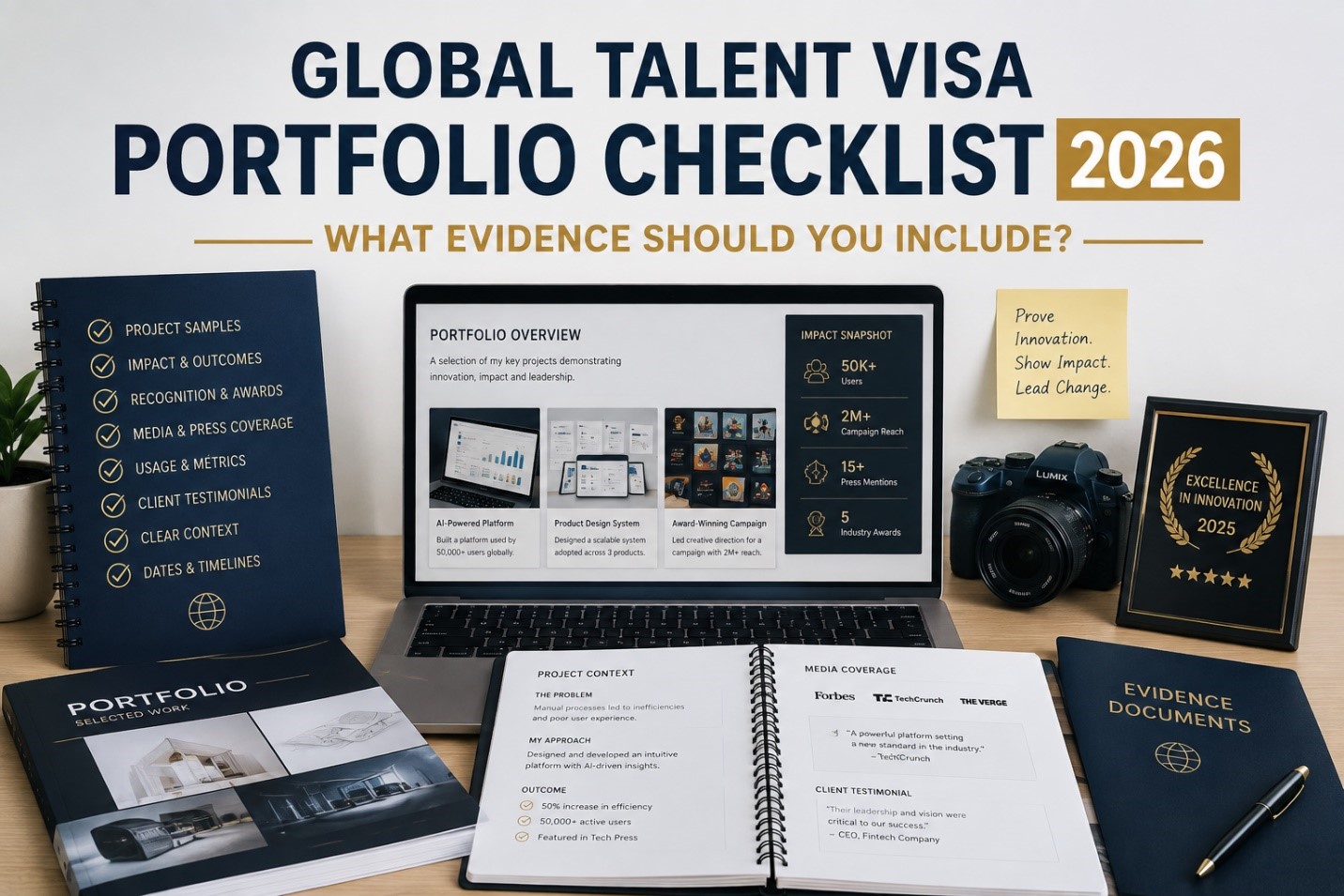
Global Talent Visa Portfolio Checklist 2026: What Evidence Should You Include?
A portfolio is one of the most persuasive parts of a Global Talent Visa application when it is built well, and one of the weakest when it is not. Unlike a CV or personal statement, a Global Talent Visa portfolio lets reviewers see your work directly rather than reading a description of it. Going into 2026, expectations around what a strong portfolio should include have become more specific, and applicants who treat it as an afterthought tend to submit thinner cases than they need to. This checklist walks through what belongs in a well-built Global Talent Visa checklist for your portfolio, how to organise it, and where applicants commonly fall short. Why Your Portfolio Carries So Much Weight Written claims are easy to make. A portfolio makes them harder to dispute. If you say you designed an award-winning product, built a widely used platform, or produced influential creative work, a well-curated portfolio lets a reviewer see the evidence directly rather than taking your word for it. This is why Global Talent portfolio evidence often has more persuasive weight, document for document, than almost anything else in your application. It also gives reviewers context they cannot get elsewhere. A single screenshot of an app rarely tells the full story, but a portfolio that includes design process, outcomes, and third-party recognition builds a much richer, more credible picture of your work. The Core Checklist for 2026 While exact requirements vary by route, most strong portfolios in 2026 include the following elements: A short introduction explaining your role and specific contribution to each featured project. Visual or written samples of your best, most relevant work, clearly dated. Context for each project: the problem, your approach, and the measurable outcome. Evidence of recognition tied to the work, such as press coverage, awards, or client testimonials. Usage or impact data where available, such as audience reach, sales figures, or adoption numbers. Clear labelling and consistent formatting so reviewers can navigate quickly between projects. The strongest portfolios are curated, not comprehensive. Including every project you have ever worked on dilutes the impact of your best work. Aim for a smaller number of standout pieces, each supported by real context and outcomes, rather than a long list of minor contributions. Meeting Global Talent Portfolio Requirements by Route Portfolio expectations shift depending on your field. A designer or artist’s portfolio will lean heavily on visual samples and critical or press recognition, while a technologist’s portfolio may focus more on product outcomes, technical documentation, and usage metrics. Researchers, meanwhile, often build a portfolio around published work, citation data, and evidence of influence within their field. Whatever your route, the underlying Global Talent portfolio requirements stay consistent: clarity of contribution, evidence of quality, and proof of recognition or impact. Tailor the format to your field, but keep the underlying structure focused on these three pillars. Organising Your Portfolio for Fast Review Reviewers move through a high volume of applications, so structure matters as much as content. Group your portfolio by project or theme rather than chronologically dumping everything together. Open with your strongest piece of work, since first impressions genuinely influence how the rest of the portfolio is read. Keep file formats simple and accessible. PDFs with embedded images tend to work more reliably than links to external sites, which can break, require login access, or simply go unclicked. If external links are necessary, back them up with screenshots inside the main document. Common Portfolio Mistakes to Avoid The most common issue is including work without explaining your individual contribution, particularly for team-based projects. A stunning piece of design or a highly successful product means very little to a reviewer if it is unclear what part of it was actually yours. Always be explicit about your specific role. Another frequent mistake is outdated content. A portfolio dominated by work from many years ago can suggest stalled momentum, even if your recent work is stronger. Prioritise recent projects, and where older work is included, pair it with something current to show continued growth. How Much Is Too Much? A question we hear often is simply how many pieces of work to include. There is no fixed number, but as a general guide, most strong portfolios feature between six and twelve well-documented pieces of work rather than a handful of thin entries or an overwhelming archive of everything ever produced. What matters more than the count is that every single piece included earns its place, with clear context, real outcomes, and a defensible reason for being there. If you are unsure whether to include a piece of work, a useful test is to ask whether it strengthens your weakest evidence category or simply repeats a point you have already made elsewhere. Evidence that fills a genuine gap is worth including. Evidence that just adds bulk usually is not. Building a Portfolio That Does Its Job A well-built portfolio does not just showcase your work, it makes your entire application easier to believe. When it is curated, clearly labelled, and backed by real outcomes and recognition, it becomes one of the most persuasive documents in your Global Talent Visa file. At Horizon Bloom Consulting, we help applicants review, structure, and strengthen their portfolios as part of our non-legal endorsement preparation services. We do not provide immigration or legal advice, and applicants should appoint a regulated adviser for visa filing. If you want a professional review of your portfolio ahead of submission, book a consultation with our team.

Global Talent Visa Support UK: DIY vs Professional Guidance
Applying independently can feel attractive because you control every document, decision, and deadline. However, Global Talent visa support UK is not simply about completing an online form. Most applicants must first prove that they are recognised as a leader or potential leader in academia or research, arts and culture, or digital technology. The endorsement stage requires applicants to interpret field-specific criteria and connect each claim to suitable evidence rather than presenting a general career history. A do-it-yourself approach can work for someone who understands official guidance, has clear achievements, and can assess their profile objectively. The challenge is knowing whether evidence proves recognition, impact, and personal contribution. Global Talent visa application support becomes useful when a strong applicant is unsure how to select documents, structure recommendation letters, explain outcomes, or separate material that proves the criteria from background information that only describes a career without strengthening the actual endorsement case. What a Careful DIY Application Involves DIY preparation begins with identifying the correct field, pathway, and endorsement standard. Applicants should read guidance for their own discipline instead of copying a successful case from another profession. The needs vary between Digital technology, research, arts, architecture, fashion and film. Most applicants complete the endorsement and visa stages, and professional Global Talent visa assistance UK can help you understand how the rules for each field affect the evidence plan. Working independently gives you direct knowledge of the projects, results, and people who can verify your contribution. That familiarity is valuable, but it may also hide weaknesses. Applicants sometimes assume a title, article, award, salary, or metric speaks for itself. An assessor needs to understand what the applicant delivered, how the claim is verified, and why it demonstrates leadership in practice rather than routine professional competence. Where Independent Preparation Becomes Difficult The value of a Global Talent visa consultant UK becomes clearest when deciding what each document actually proves. Evidence must be relevant, consistent, readable, and matched to the chosen criterion. Digital technology applicants, for example, provide a CV, three recommendation letters, proof of a connection to a technology business where applicable, and no more than ten documents demonstrating eligibility. Other fields follow different documentary rules. Roles might overlap, projects might be confidential, achievements might be international, or you might have startup experience. These are matters that need clarification, not embellishment. An independent review may find contradictory dates, unsubstantiated numbers, redundant letters, flimsy captions, vague descriptions of accomplishments. Good Global Talent visa support UK should make it easier to understand and verify contributions, not make a career sound bigger than it is. It can clarify team ownership. What Good Professional Guidance Should Provide Good guidance should start with an honest eligibility review, not a promise of approval. A reviewer should explain which parts of the profile are strong, which claims need independent proof, and where the applicant may not yet meet the criteria. Support may cover evidence mapping, document organisation, recommendation strategy, personal-statement feedback, and a consistency check. Reliable Global Talent visa application support preserves the applicant’s voice without manufacturing claims or relying on templates. Applicants must distinguish endorsement preparation from regulated immigration advice. Evidence guidance is not the same as advising on immigration status, completing regulated visa work, or guaranteeing a Home Office outcome. Horizon Bloom Consulting states that it supports endorsement preparation and post-endorsement guidance, while Stage 2 filing should be handled by a regulated professional. A Practical Way to Choose Between Both Options Before paying for guidance, know what you can confidently do and where review adds value. A good hybrid approach involves professional Global Talent visa assistance UK: the applicant organises records, drafts and chooses recommenders, and a specialist rigorously tests strategy, checks alignment and points out gaps. Your achievements could support several criteria, but the strongest pathway and evidence combination remain unclear. Important results belong to a wider team and require precise personal attribution with supporting records. Recommenders understand your work but need guidance on useful detail, independence, examples, and structure. Your evidence includes confidential projects, complex timelines, technical language, international records, or changing formal job titles. A Global Talent visa consultant UK can review consistency, relevance, duplication, formatting, and missing proof. The choice is up to you, depending on the complexity, time, budget and confidence you have. Guidance is useful if it improves judgement and organisation. It cannot substitute for missing achievement, create recognition or endorse weak evidence. Input should clarify an authentic case, protect accuracy and help you present yourself professionally. Conclusion DIY preparation offers control and lower upfront cost, while professional guidance can bring structure, objectivity, and a clearer evidence strategy. Neither route guarantees endorsement, because the relevant endorsing body assesses whether the applicant meets its criteria. A reliable Global Talent visa support UK should strengthen presentation without changing the truth of the applicant’s career. Horizon Bloom Consulting can assist with eligibility assessment, evidence planning, recommendation guidance, portfolio organisation, and endorsement preparation, while keeping regulated immigration filing separate. Applicants should review the latest official requirements, understand the consultant’s exact scope, and choose support according to the real complexity of their case.

Innovator Founder Visa Requirements UK: Complete 2026 Guide
The 2026 Innovator Founder visa requirements UK focus on people who want to create and actively lead an original venture in Britain. This is not a general route for purchasing an existing company, opening a standard local business, or making a passive investment. A founder must bring a credible idea, explain the market problem it solves, and show how the venture can develop beyond its earliest stage. The application therefore combines personal suitability with an assessment of the proposed business. Anyone researching startup visa requirements UK should note that the former Start-up route is closed to new applicants. Qualifying entrepreneurs now consider the Innovator Founder route, which grants permission for three years. Eligible partners and children may apply as dependants, while founders who later satisfy the separate settlement rules may apply for indefinite leave to remain after three years. The route begins with endorsement and continues through business progress checks. How the Business Idea Is Judged A founder needs more than an attractive pitch when applying through the innovative business visa UK route. The venture must be new, viable, and scalable. New means the applicant cannot simply join a company that is already trading. Innovation requires a new strategy that satisfies a market need or provides a significant competitive advantage. Viability looks at whether the model is reasonable given the skills, knowledge, resources and understanding of the market of the founder. Scalability looks at more than one operation and asks whether the concept can grow in an organised, sustainable way. During a review of business eligibility UK, assessors expect growth, job creation, capacity and expansion into international markets. The applicant must have created the plan or contributed to it and be the founder or a founding-team member. Passive investors without responsibility do not qualify. Why Endorsement Comes Before the Visa Before applying for the visa, the founder must obtain endorsement from an organisation authorised by the Home Office. The endorsing body examines the proposal, the applicant’s role, commercial credibility, and the source of any funds going into the venture. This stage is where the Innovator Founder visa requirements UK become practical: the plan, founder profile, market evidence, and finances must align. The endorsement letter must normally be dated no more than three months before the immigration application. Applicants should approach only bodies on the list and should understand each provider’s assessment process before submitting material. After the visa is granted, the founder must attend at least two contact-point meetings, around months 12 and 24, to demonstrate progress. An endorsing body may withdraw support when the venture is abandoned, or route conditions are no longer met. Personal Conditions and Evidence Checklist Personal requirements matter alongside the business proposal. Anyone comparing startup visa requirements UK with the current route should prepare evidence of English ability at CEFR level B2 unless an exemption applies. Applicants entering from overseas, or applying inside the UK after holding permission for less than 12 months, normally need £1,270 in maintenance funds held for 28 consecutive days. Additional amounts apply when eligible dependants are included. The supporting file should remain orderly, current, and consistent with the business plan. It should also explain how personal evidence supports the wider case for an innovative business visa UK application rather than appearing as unrelated paperwork. Valid passport and proof of identity for visa submission. Endorsement letter issued within the permitted validity period. English-language evidence clearly showing no exemption applies. Bank statements clearly demonstrating the required maintenance funds. Tuberculosis certificate and certified translations where they apply. What Approval Means for the Founder After endorsement, the founder completes the visa application online and provides identity and supporting documents. The immigration form, business plan, endorsement letter, and personal evidence should present one consistent account of the venture. At this point, business eligibility in the UK remains important because discrepancies can weaken an otherwise credible case. Successful applicants normally receive three years of permission and may establish businesses, work for their venture, and bring eligible dependants. During the three-year grant, the holder can direct the endorsed venture and may take qualifying work outside it when the job meets the required skill level. Professional sportsperson work is not permitted. Settlement is a separate assessment requiring business progress, a new endorsement, continuous residence, and the Life in the UK Test where applicable. Meeting the Innovator Founder visa requirements in the UK begins the founder’s continuing responsibilities. Conclusion A strong Innovator Founder application is built on consistency. The business idea, market evidence, financial assumptions, founder experience, and endorsement materials should all support the same credible story. Applicants also need to understand that approval creates ongoing duties, including active management and progress reviews with the endorsing body. Horizon Bloom Consulting can help founders examine eligibility, organise evidence, prepare for endorsement, and identify weaknesses before formal submission. Careful preparation does not guarantee a visa decision, but it can make the case clearer, more accurate and easier to assess. Before spending any money or sending off an application, make sure you check the current official rules.

Common Reasons Global Talent Visa Endorsement Applications Are Rejected
A strong career does not automatically lead to a successful Global Talent visa endorsement UK decision. Endorsing bodies assess whether an applicant has proved recognition as a leader or potential leader in the relevant field. They do not simply count senior titles, years of experience, awards, or famous employers. Many applications fall short because impressive achievements are listed without explaining personal ownership, measurable influence, or their connection to the selected endorsement criteria. Another frequent mistake is treating endorsement like an ordinary employment application. The CV, letters, statement, and evidence must work together because the UK Global Talent endorsement requirements call for one focused professional story across the file. Conflicting dates, repeated claims, vague descriptions, or company results presented without the applicant’s individual role can create doubt. Strong preparation means selecting the clearest proof, explaining its relevance, and making the assessor’s task easier rather than submitting every available document during review. Choosing the Wrong Route or Talent Level Choosing the wrong field, pathway, or talent level can undermine a credible profile. Digital technology applicants must demonstrate recent recognition and satisfy the required criteria for exceptional talent or exceptional promise. Weak endorsement evidence UK often begins with poor positioning: an established-leader case may rely mostly on early-career potential, while a promise case may present achievements that are dated, routine, or disconnected from digital technology. The chosen category should fit the applicant’s current standing, not a future ambition. Assessors need to see why each achievement supports the route selected. Documents may look impressive in isolation but still fail to prove the mandatory criterion and the required optional criteria. Mapping every item to one purpose helps prevent confusion and shows exactly what each document establishes within the Global Talent endorsement application submitted for assessment by specialists. Evidence That Shows Activity but Not Personal Impact Evidence can be genuine yet still fail to prove personal contribution. Press coverage may describe the company rather than the individual. Revenue figures may confirm growth without showing who created the strategy. Product screenshots may prove that something exists but not that the applicant designed, built, or scaled it. Useful documents combine independent verification, dates, measurable outcomes, and an account of responsibility. For these cases, GOV.UK permits a maximum of ten evidence documents alongside the CV and recommendation letters. A carefully planned Global Talent visa endorsement UK submission uses that allowance well and with appropriate restraint. Each item should explain what happened, what the applicant did, why the result mattered, and which criterion it supports. Unsupported captions, cropped analytics, internal praise, and unexplained team achievements can leave claims unproven. Recommendation Letters That Add Little Proof Recommendation letters are not valuable because they come from senior people. They should show knowledge of the applicant’s work, explain achievements, and offer comparison with others in the sector. In practical assessment, the UK Global Talent endorsement requirements suffer when letters repeat the CV, use identical wording, make broad claims, or fail to explain how the recommender knows the applicant. The file must remain consistent. Dates, titles, company names, project descriptions, metrics, and future plans should align. Doubt can arise when letters claim leadership that the documents do not demonstrate, or when the personal statement introduces achievements found nowhere else. Independent examples, specific observations, and verifiable results carry more weight than praise that cannot be checked against the submitted material, which otherwise becomes weak endorsement evidence UK for the assessor. Avoidable Presentation and Review Mistakes Some refusals reflect presentation problems rather than an absence of achievement. Before submission, applicants should examine the evidence pack as an assessor would and remove confusion, repetition, and unsupported assumptions. Give every document a readable date, source, and title. Match each item to one criterion, not several unrelated claims. Explain personal responsibility when evidence describes a company or team. Remove repeated screenshots that add no independent proof. Keep names, roles, metrics, and timelines consistent throughout. An organised Global Talent endorsement application doesn’t require language or oversized files. It requires material that can be verified and understood. Applicants must describe specialised work in simple terms, provide context for metrics and separate job duties from wider sector contributions. Claims should not exist only in captions or statements. If endorsement is refused, a review is available when the applicant believes a decision error occurred, but it is not an opportunity to rebuild the case with new evidence. Conclusion A refusal does not always mean the applicant lacks talent; it often means the submitted case did not prove clearly enough. A Global Talent visa endorsement UK file at every stage should show recent recognition, personal impact, independent validation, and consistent evidence matched to the chosen criteria. Horizon Bloom Consulting supports applicants through eligibility review review, evidence planning, recommendation guidance, and endorsement preparation, helping them identify weaknesses before submission. No adviser can guarantee approval, because the endorsing body makes the decision. Applicants should check current official guidance and seek regulated immigration advice where legal interpretation or personal visa circumstances require it.
